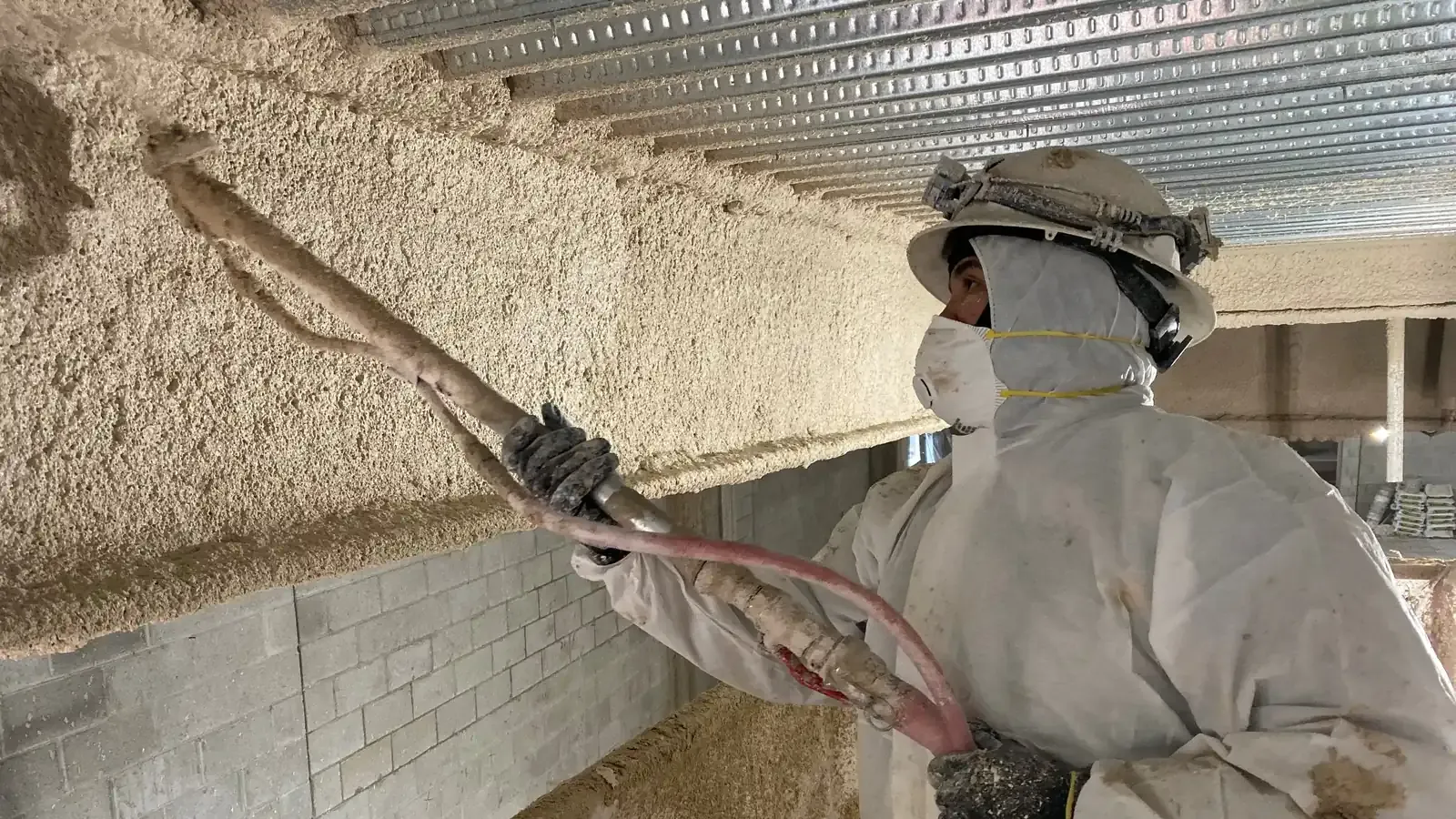
Fireproofing Inspection: SFRM and Intumescent Special Inspection
Fireproofing inspection is the special inspection and testing of sprayed fire-resistive materials (SFRM) and intumescent fire-resistive materials (IFRM) on structural steel, required by Sections 1705.15 and 1705.16 of the 2025 California Building Code (CBC) and 2024 IBC. The inspector checks substrate, thickness, density and bond strength against the approved fire-resistance design.

This page is for owners, owner's representatives, general contractors and fireproofing subcontractors who need to scope, schedule and close out fireproofing special inspection on a permitted project. It covers when the inspection is required, what the inspector checks, the code acceptance limits, what the owner receives and where the inspection stops. The step-by-step test procedures are in our guide to SFRM thickness and density testing.
On this page: when it is required · what is checked · thickness, density and bond limits · intumescent coatings · sampling and a worked example · reports · limits · FAQ
When is fireproofing special inspection required?
Fireproofing special inspection is required when a permitted building relies on SFRM or IFRM to give structural members or assemblies their fire-resistance rating. The owner or the owner's authorized agent, other than the contractor, must employ an approved agency for the special inspections listed in Section 1705, under 2025 CBC Section 1704.2.
The 2025 CBC applies to building permit applications received on or after January 1, 2026, according to the Building Standards Commission's Information Bulletin 25-01. Projects that applied on or before December 31, 2025 generally remain under the 2022 CBC, so confirm the edition on your permit before you scope the inspection.
The numbering matters because it has moved between editions. In both the 2024 IBC and the 2025 CBC, SFRM is Section 1705.15 and intumescent materials are Section 1705.16; older specifications may still cite earlier numbers. For hospitals regulated by HCAI and for schools and essential services buildings regulated by DSA, the same requirements appear in CBC Chapter 17A as Sections 1705A.15 and 1705A.16.
The 2025 CBC sets out the scope of SFRM inspection in Section 1705.15:
"Special inspections and tests of sprayed fire-resistive materials (SFRM) applied to floor, roof and wall assemblies and structural members shall be performed in accordance with Sections 1705.15.1 through 1705.15.6. Special inspections shall be based on the fire-resistance design as designated in the approved construction documents." (2025 CBC Section 1705.15)
That last sentence is the key to the whole inspection. The inspector does not decide how thick or dense the fireproofing should be; the listed fire-resistance design shown on the approved drawings does. Section 1704.3 assigns the statement of special inspections to the registered design professional in responsible charge, and the fireproofing items should appear there.
The inspection also continues after spraying. Section 1705.15 calls for an additional visual inspection after the rough installation of electrical, automatic sprinkler, mechanical and plumbing systems and ceiling suspension systems, and before concealment where applicable. Other trades often scrape, cut or knock off fireproofing while hanging their work, and that damage is easy to miss once the ceiling closes.
What does a fireproofing inspection check?
A fireproofing inspection checks five items listed in 2025 CBC Section 1705.15.1, to show compliance with the listing and the fire-resistance rating. The table below lists them with the code section that governs each one.
Item checked (CBC 1705.15.1) | What the special inspector verifies | Governing section |
|---|---|---|
Condition of substrates | Steel prepared per the approved design and the manufacturer's written instructions; inspected before spraying | 1705.15.2 |
Application conditions | Minimum substrate and ambient temperature before and after application; ventilation, per the manufacturer | 1705.15.3 |
Thickness of application | Readings against the design thickness and the minimum allowable thickness, by ASTM E605 | 1705.15.4 |
Density | Density in pounds per cubic foot, not less than the design value, by ASTM E605 | 1705.15.5 |
Bond strength (cohesion/adhesion) | Not less than 150 psf, by the ASTM E736 field test | 1705.15.6 |
Condition of finished application | Visual check of the completed work, and again after other trades' rough-in | 1705.15, 1705.15.1 |
Surface condition before spraying
The special inspector inspects the prepared surface of structural members before any SFRM is applied, under 2025 CBC Section 1705.15.2. The surface must be prepared in accordance with the approved fire-resistance design and the manufacturer's written instructions. Mill scale, oil, loose rust, dirt and unexpected primers are the usual problems at this stage.
Primers and paints need attention before spraying starts. Section 1705.15.6.3 requires bond tests to qualify a primer, paint or encapsulant where acceptable bond performance with the SFRM has not been established. If those bond strengths come in below the required values, a bonding agent approved by the SFRM manufacturer must be applied.
Spray applied fireproofing inspection during application
During application, spray applied fireproofing inspection confirms the conditions the manufacturer sets for the product. Section 1705.15.3 requires the substrate to be at the minimum ambient temperature before and after application, and the area to be ventilated during and after application, as stated in the manufacturer's written instructions. The inspector also confirms that the product being sprayed is the one named in the listed design.
What are the SFRM thickness, density and bond strength limits?
The 2025 CBC sets numerical acceptance limits for SFRM inspection in Sections 1705.15.4 through 1705.15.6. Thickness and density are measured by ASTM E605/E605M, and bond strength by the field test in ASTM E736/E736M.
Property | Acceptance limit | Test method | Section |
|---|---|---|---|
Thickness (all readings) | Not more than 10% of readings below the design thickness | ASTM E605 | 1705.15.4 |
Thickness (individual reading), design 1 in or greater | Not less than design thickness minus 1/4 in (6.4 mm) | ASTM E605 | 1705.15.4.1 |
Thickness (individual reading), design less than 1 in | Not less than design thickness minus 25% | ASTM E605 | 1705.15.4.1 |
Density | Not less than the density in the approved fire-resistance design | ASTM E605 | 1705.15.5 |
Bond strength (cohesive/adhesive) | Not less than 150 psf (7.18 kN/m²) | ASTM E736 field test | 1705.15.6 |
Thickness
Thickness varies naturally across a deck flute or around a beam flange, so the code judges it by the spread of readings, not one number. Section 1705.15.4 allows no more than 10 percent of thickness readings to fall below the design thickness, and no single reading may fall below the minimum allowable thickness in Section 1705.15.4.1. An average that meets the design value does not pass if those two conditions are not met.
ASTM E605/E605M is the method the code names. ASTM describes its scope as covering "procedures for determining thickness and density of sprayed fire-resistive material (SFRM)," for both sprayed fiber and cementitious types, in the field and the laboratory. The code adds location rules by deck type and member type, summarized in the sampling table below.
Density
Density is a separate pass/fail criterion from thickness. Under Section 1705.15.5, the density of the SFRM must be not less than the density specified in the approved fire-resistance design, determined by ASTM E605. A coating can meet its thickness and still fail density if it was mixed or applied outside the manufacturer's instructions, so both results are needed.
Bond strength
Bond strength measures whether the cured SFRM holds together (cohesion) and stays on the steel (adhesion). Section 1705.15.6 requires a cohesive/adhesive bond strength of not less than 150 psf, which is about 1.04 psi, determined by the field test in ASTM E736/E736M. ASTM describes that standard as measuring the bond strength "perpendicular to the surface" of SFRM applied to rigid backing.
The detailed procedures for each test (how readings are taken, how density samples are cut and weighed, how the bond fixture is attached and pulled) are in our SFRM inspection guide. This page keeps to what is required and how it is accepted.
How is IFRM inspection different from SFRM inspection?
IFRM inspection follows a different document. Under 2025 CBC Section 1705.16, special inspections and tests for intumescent fire-resistive materials applied to structural elements and decks are performed in accordance with AWCI 12-B, based on the fire-resistance design in the approved construction documents.
"Special inspections and tests for intumescent fire-resistive materials applied to structural elements and decks shall be performed in accordance with AWCI 12-B." (2025 CBC Section 1705.16)
CBC Chapter 35 identifies that document as AWCI Technical Manual 12-B, Third Edition (2014), a standard practice for the testing and inspection of field-applied thin-film intumescent fire-resistive materials. The ICC listing for Technical Manual 12-B says it provides field inspection procedures and testing criteria for thickness measurement of applied coatings. Intumescent coatings are thin, paint-like films that expand into an insulating char when heated, so dry film thickness against the listed design is the central measurement.
For IFRM inspection, the inspector works from the approved listing: the product, the required dry film thickness for each member size, any required primer and topcoat, and the substrate condition. Section 1705.16 also requires inspection during construction and an additional visual inspection after rough installation of electrical, sprinkler, mechanical and plumbing systems, and before concealment where applicable. If a project uses both SFRM and IFRM, the inspection scope should say which system goes on which members.
How often is SFRM sampled, and what does that look like on a real floor?
SFRM sampling rates depend on the property, the assembly and the member type. The rates below are from 2025 CBC Sections 1705.15.4 through 1705.15.6; Section 1705.15 also states that the required sample size shall not exceed 110 percent of that specified by the referenced standards.
Test | Floor, roof and wall assemblies | Structural members |
|---|---|---|
Thickness | At least 4 measurements per 1,000 sq ft of sprayed area, or portion, in each story (1705.15.4.2) | At least 25% of structural members on each floor (1705.15.4.5) |
Thickness locations | Cellular and fluted decks: 12 in × 12 in square, at least 4 measurements; fluted decks include valley, crest and sides, average reported (1705.15.4.3, .4) | Beams and girders 9 locations, joists and trusses 7, wide-flange columns 12, HSS and pipe columns at least 4, at each end of a 12 in length (1705.15.4.6 to .9) |
Density | At least 1 sample per 2,500 sq ft of sprayed area, or portion, in each story (1705.15.5) | At least 1 sample per member type per 2,500 sq ft of floor area, or portion, in each story (1705.15.5) |
Bond strength | At least 1 sample per 2,500 sq ft of sprayed area, or portion, in each story (1705.15.6.1) | At least 1 sample per member type per 2,500 sq ft of floor area, or portion, in each story (1705.15.6.2) |
Worked example: one 12,000 sq ft story
Take one story with 12,000 sq ft of floor area and SFRM on the full fluted floor deck. The steel framing on that story has 88 wide-flange beams and girders and 32 wide-flange columns, 120 members in total. The listed design calls for 1-1/4 in on the deck and 3/4 in on the columns.
Deck thickness. 12,000 ÷ 1,000 = 12 portions, and 12 × 4 = 48 thickness measurements at minimum. Not more than 10 percent of the 48 may be below 1-1/4 in: 10 percent of 48 is 4.8, so 4 low readings are acceptable and 5 (10.4 percent) are not. Because the design is 1 in or more, no reading may be below 1-1/4 − 1/4 = 1.00 in.
Member thickness. 25 percent of 120 members is 30 members, for example 22 beams and 8 columns. Each beam gets 9 readings at each end of a 12 in length, so 22 × 9 × 2 = 396 readings; each column gets 12 at each end, so 8 × 12 × 2 = 192 readings, 588 member readings in all. The columns' design is less than 1 in, so their minimum individual reading is 3/4 − 25 percent = 0.5625 in, or 9/16 in.
Density and bond. 12,000 ÷ 2,500 = 4.8, rounded up to 5 because each "portion thereof" counts. The deck needs 5 density samples and 5 bond samples. The members need 1 sample per type per 2,500 sq ft: 2 types × 5 = 10 density samples and 10 bond samples, for 15 of each on the story.
These are code minimums for one story. The project specification, the statement of special inspections or the building official can require more, and the inspector applies the governing rules to the actual assemblies and members on the drawings. Sampling frequency is also not the same as visit frequency, which depends on how the fireproofing contractor sequences the floors.
What does the owner receive from a fireproofing inspection?
The owner receives written reports. Under 2025 CBC Section 1704.2.4, the approved agency keeps records of special inspections and tests and submits reports to the building official and to the registered design professional in responsible charge, at the frequencies the approved construction documents or the building official require. Each report must describe the nature and extent of the inspections and tests, where they were performed, and whether the work conformed to the approved construction documents.
For fireproofing, a useful report records each tested location by floor, grid line and member, the listed design and its required thickness and density, the individual readings, the density and bond results, and any area that did not conform. It also records the post-rough-in visual inspection and any damage found. Clear locations let the fireproofing contractor find and repair the exact area without retesting a whole floor.
Section 1704.2.4 also requires a final report documenting the required special inspections and tests and the correction of any discrepancies. It is submitted to the building official at a point agreed before work starts by the owner or the owner's authorized agent. Fireproofing results usually feed that final report, which is one of the documents the building official uses at close-out.
What happens if fireproofing fails inspection?
When a reading, sample or visual check fails, the inspector documents the condition and tells the contractor. Section 1704.2.4 says discrepancies shall be brought to the immediate attention of the contractor for correction. If they are not corrected, they go to the building official and the registered design professional before that phase of work is completed.
A typical sequence follows these steps:
- Record the location, member or assembly, the reading or test result, and the requirement it missed.
- Notify the general contractor and fireproofing subcontractor under the project's reporting procedure.
- Agree the repair: added material for thin areas, removal and reapplication for low density or poor bond, or a bonding agent where a coated surface failed its qualification test.
- Reinspect or retest the repaired area, and record the result against the original discrepancy.
The inspection agency observes, tests, documents and reports. The design professional, the manufacturer and the building official decide how a nonconforming condition is resolved, and any change to the listed design is theirs to approve.
How should you prepare for a fireproofing inspection?
Preparing the documents and access before the first visit avoids most delays. Before you request a fireproofing inspection, have these ready:
- Approved construction documents showing the fire-resistance design and rating for each assembly and member
- The listed design number (for example, a UL design) and the product named in it
- Manufacturer product data and written application instructions
- Project specifications and the statement of special inspections
- Information on any primers, paints or encapsulants on the steel, so bond qualification can be planned
- Floor plans and member marks so test locations can be identified
- The schedule for spraying, MEP rough-in, ceiling installation and concealment
Fireproofing often runs alongside other special inspections. Structural steel inspection of welding and bolting should be finished in an area before fireproofing covers the connections. Firestop inspection of penetrations and joints is a separate requirement under 2025 CBC Section 1705.18, and it should be sequenced so the two trades do not damage each other's work.
What can fireproofing inspection not tell you?
Fireproofing inspection verifies that installed material matches the approved design; it does not check whether the design is right. Selecting the listed design, the required thickness for each member size and the fire-resistance rating is the work of the registered design professional, reviewed by the building official. Equivalency calculations and engineering judgments for conditions outside a listing are also outside the inspector's role.
The tests are samples, not a full survey. A passing set of readings at the code frequency gives reasonable confidence in a floor, but it cannot prove that every square foot between test points meets the design. That is one reason the post-rough-in visual inspection matters.
Other limits apply too:
- SFRM thickness and density readings do not assess how the material will perform in a real fire; that performance comes from the fire test behind the listing.
- IFRM inspection follows AWCI 12-B and the product listing, and the SFRM rules in Section 1705.15 do not transfer to intumescent coatings.
- Firestop systems at penetrations and joints are inspected under Section 1705.18 (ASTM E2174 for penetration firestops, Section 1705.18.2 for joint systems), not under the fireproofing sections.
- Damage after the final visual inspection, for example from later tenant improvements, is not covered by the original inspection.
How SierraPoint Industries can help
SierraPoint Industries is an independent inspection agency providing special inspection, nondestructive testing (NDT), QA/QC oversight, Certified Welding Inspector (CWI) services and third-party auditing. Its IAS accreditation (SIA-442, AC291 and ISO/IEC 17020, scope written to 2025 CBC Chapter 17A) includes sprayed fire-resistant materials (CBC 1705A.15) and mastic and intumescent fire-resistant coatings (CBC 1705A.16). SierraPoint Industries can discuss fireproofing inspection on your project against 2025 CBC Sections 1705.15 and 1705.16 and the approved fire-resistance design. See our special inspection services, or contact us with your drawings, listed design and schedule.
Sources
- ICC, 2025 California Building Code, Title 24 Part 2, Chapter 17, Sections 1704.2, 1704.2.4, 1704.3, 1705.15, 1705.16, 1705.18: https://codes.iccsafe.org/content/CABC2025P1/chapter-17-special-inspections-and-tests
- ICC, 2025 California Building Code, Chapter 17A, Sections 1701A.1.1, 1705A.15, 1705A.16: https://codes.iccsafe.org/content/CABC2025P1/chapter-17a-special-inspections-and-tests
- ICC, 2025 California Building Code, Chapter 35 Referenced Standards (AWCI 12-B—14, ASTM E605/E605M—19, ASTM E736/E736M—19): https://codes.iccsafe.org/content/CABC2025P1/chapter-35-referenced-standards
- ICC, 2024 International Building Code, Chapter 17, Sections 1705.15 and 1705.16: https://codes.iccsafe.org/content/IBC2024V1.0/chapter-17-special-inspections-and-tests
- California Building Standards Commission, Information Bulletin 25-01 (2025 code effective date): https://www.dgs.ca.gov/-/media/Divisions/BSC/06-News/Information-Bulletins/2025/BSC-Bulletin-25-01-FINAL.pdf
- ASTM E605/E605M-19(2023), scope page: https://store.astm.org/e0605_e0605m-19r23.html
- ASTM E736/E736M-19(2023), scope page: https://store.astm.org/e0736_e0736m-19r23.html
- AWCI Technical Manual 12-B, ICC store listing: https://shop.iccsafe.org/technical-manual-12-b.html
Frequently Asked Questions
- What is SFRM inspection?
- SFRM inspection is the special inspection and testing of sprayed fire-resistive material under 2025 CBC Section 1705.15. It covers the condition of the substrate, application conditions, thickness, density, cohesive/adhesive bond strength and the condition of the finished work, all checked against the fire-resistance design in the approved construction documents.
- Who hires the fireproofing special inspector?
- The owner or the owner's authorized agent hires the special inspection agency, and that agent cannot be the contractor, under 2025 CBC Section 1704.2. The agency reports to the building official and to the registered design professional in responsible charge. The fireproofing subcontractor does its own quality control, which does not replace special inspection.
- How often is spray-applied fireproofing tested?
- Spray-applied fireproofing is tested at rates set by 2025 CBC Sections 1705.15.4 through 1705.15.6. Thickness on floor, roof and wall assemblies needs at least four measurements per 1,000 sq ft per story, and 25 percent of structural members on each floor. Density and bond strength need at least one sample per 2,500 sq ft, and one per member type per 2,500 sq ft of floor area.
- What is the minimum bond strength for SFRM?
- The minimum cohesive/adhesive bond strength for cured SFRM is 150 psf (7.18 kN/m²), about 1.04 psi, under 2025 CBC Section 1705.15.6. It is measured with the field test in ASTM E736. Where the steel is primed or painted and bond with that coating has not been established, bond tests must qualify the surface first.
- Which standards are used for fireproofing inspection?
- Fireproofing inspection uses ASTM E605/E605M for SFRM thickness and density, ASTM E736/E736M for cohesion/adhesion, and AWCI Technical Manual 12-B for intumescent fire-resistive materials. The 2025 CBC references the 2019 editions of the two ASTM methods. The listed fire-resistance design in the approved drawings sets the values the results are measured against.
- Do intumescent coatings need special inspection?
- Intumescent fire-resistive materials applied to structural elements and decks need special inspection under 2025 CBC Section 1705.16, performed in accordance with AWCI 12-B. The inspection is based on the fire-resistance design in the approved construction documents. It includes inspection during construction and a visual inspection after MEP rough-in and before concealment, where applicable.
Need Inspection, NDT, or Auditing Services?
Whether you need a special inspector for an active construction project, NDT services for structural steel, shop inspection at a fabrication facility, or an independent third-party audit, SierraPoint Industries can provide qualified personnel to support your project.