Concrete Inspection and Reinforcing Steel Special Inspection
Concrete inspection under CBC and IBC Section 1705.3 is the owner-funded special inspection of reinforcing steel, formwork, concrete placement and field sampling on permitted structural work. Table 1705.3 lists 14 items: reinforcement placement and formwork are periodic, while sampling and testing fresh concrete and observing placement are continuous.

On this page: What it covers · Continuous vs periodic · Rebar · Placement · Field tests · How many cylinders · Shotcrete and post-tensioning · Preparing · Limits · FAQ
What does concrete special inspection cover?
Concrete special inspection covers the structural concrete work listed in Table 1705.3 of the 2025 California Building Code and the 2024 International Building Code. The table is the same in both editions. It runs from reinforcement and cast-in anchors through mix verification, fresh-concrete testing, placement, curing, prestressing and precast erection.
The section opens with a plain instruction:
"Special inspections and tests of concrete construction shall be performed in accordance with this section and Table 1705.3." (2024 IBC and 2025 CBC, Section 1705.3)
The work is in addition to the building department's own inspections. Under Section 1704.2, the owner or the owner's authorized agent, other than the contractor, employs the approved agency and identifies it to the building official. The contractor may employ the agency only where the contractor is also the owner (Exception 4). For how special inspection fits around permit inspections, see what is special inspection.
Which concrete work is exempt?
Section 1705.3 lists five exceptions. Special inspection is not required for:
- isolated spread footings of buildings three stories or less above grade plane, fully supported on earth or rock;
- continuous footings under light-frame walls of such buildings, where the footings follow Table 1809.7 and the design uses f′c of no more than 2,500 psi;
- nonstructural slabs on ground, including prestressed slabs on grade with an effective prestress below 150 psi;
- foundation walls built to Table 1807.1.6.2;
- patios, driveways and sidewalks on grade.
The 2025 CBC adds a California limit: for buildings under its [OSHPD 1R, 2 & 5] banner, exceptions 1 through 4 are not permitted. The approved construction documents and the Statement of Special Inspections still decide what applies to a given permit.
Which concrete inspection items are continuous and which are periodic?
Continuous special inspection means the special inspector is present while the work is performed. Periodic means the inspector is present intermittently, at stages the Statement of Special Inspections defines. The table below is condensed from Table 1705.3 as published on ICC Digital Codes for the 2024 IBC and the 2025 CBC.
Item | Table 1705.3 task | Continuous or periodic | Referenced standard |
|---|---|---|---|
1 | Inspect reinforcement, including prestressing tendons, and verify placement | Periodic | ACI 318: Ch. 20, 25.2, 25.3, 26.6.1–26.6.3 |
2a | Verify weldability of reinforcing bars other than ASTM A706 | Periodic | AWS D1.4; ACI 318: 26.13.1.4 |
2b | Welding of reinforcement for special moment frames, boundary elements of special structural walls and coupling beams | Continuous | AWS D1.4; ACI 318: 26.13.3 |
2c, 2d | Welded reinforcement splices; welding of primary tension reinforcement in corbels | Continuous | — |
2e, 2f | Single-pass fillet welds (maximum 5/16 in.); all other welds | Periodic | AWS D1.4; ACI 318: 26.13.3 |
3 | Anchors cast in concrete | Periodic | ACI 318: 26.13.3.3 |
4a | Adhesive anchors installed horizontally or upwardly inclined to resist sustained tension | Continuous | ACI 318: 26.13.3.2 |
4b | Mechanical anchors and other adhesive anchors | Periodic | ACI 318: 26.13.3 |
5 | Verify use of the required design mix | Periodic | ACI 318: Ch. 19, 26.4.3, 26.4.4 |
6 | Before placement: make strength specimens, run slump and air content tests, measure concrete temperature | Continuous | ASTM C31, ASTM C172; ACI 318: 26.5, 26.12 |
7 | Concrete and shotcrete placement for proper application techniques | Continuous | ACI 318: 26.5 |
8 | Maintenance of specified curing temperature and techniques | Periodic | ACI 318: 26.5.3–26.5.5 |
9a, 9b | Prestressed concrete: application of prestressing forces; grouting of bonded tendons | Continuous | ACI 318: 26.10 |
10 | Erection of precast members | Periodic | ACI 318: 26.9 |
11 | Precast diaphragm connections and joint reinforcement (MDE or HDE) in Seismic Design Category C to F | Continuous | ACI 318: 26.13.1.3; ACI 550.5 |
12 | Installation tolerances of precast diaphragm connections | Periodic | ACI 318: 26.13.1.3 |
13 | In-situ strength before stressing tendons and before removing shores and forms from beams and structural slabs | Periodic | ACI 318: 26.11.2 |
14 | Formwork shape, location and dimensions | Periodic | ACI 318: 26.11.1.2(b) |
Two footnotes matter in the field. For post-installed anchors, the anchor's research report sets the inspection requirements; where it is silent, the registered design professional specifies them and the building official approves them before work starts. In the 2025 CBC, buildings under the [OSHPD 1R, 2 & 5] banner also require adhesive anchors installed horizontally or overhead to be placed by an ACI/CRSI Certified Adhesive Anchor Installer, with stated exceptions.
Section 1705.3.1 adds that special inspection of reinforcing bar welding, and the qualification of the inspector who performs it, follow AWS D1.4.
What does a rebar inspection check before the pour?
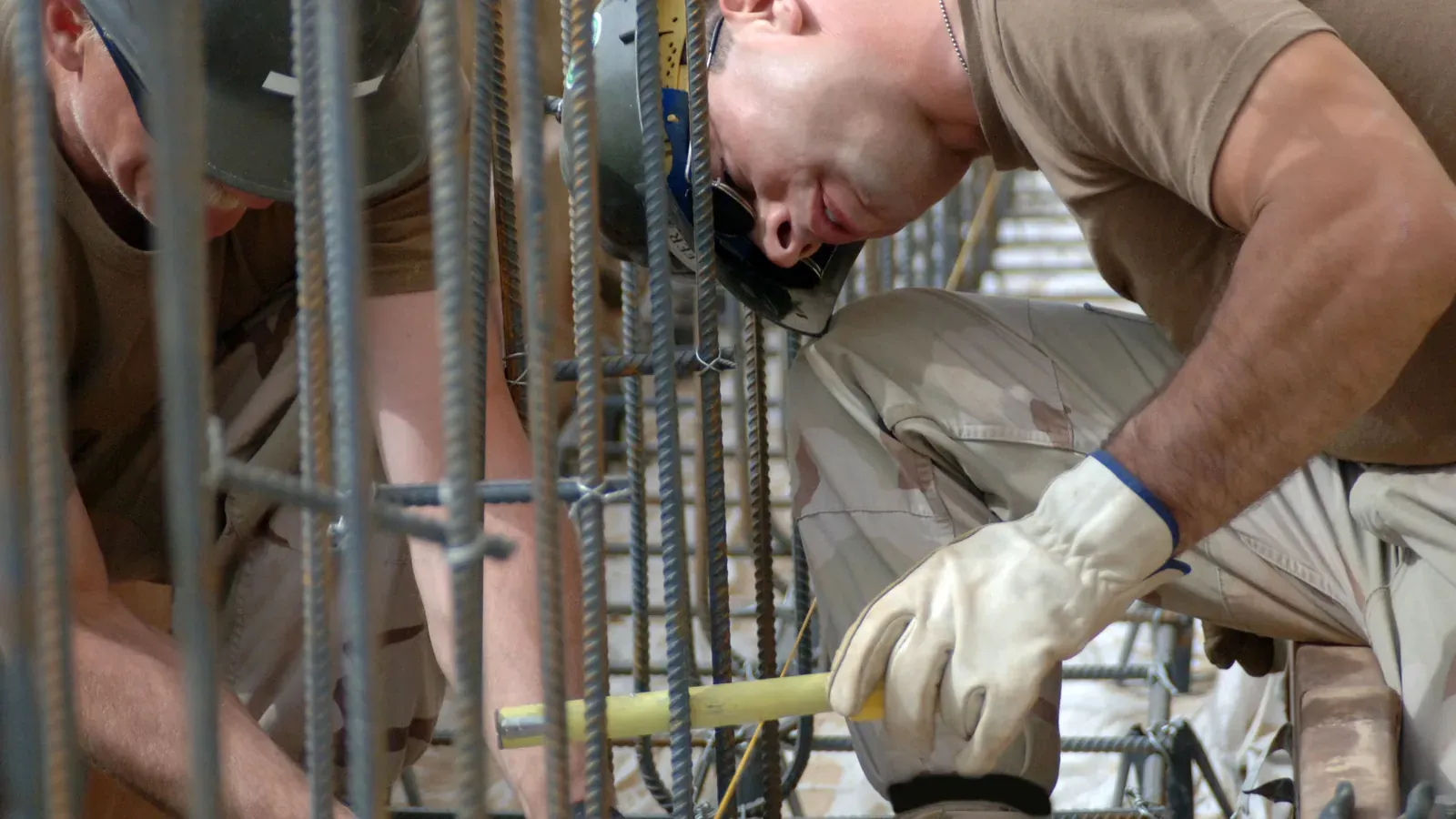
A rebar inspection compares the installed reinforcement with the approved structural drawings and the referenced ACI 318 provisions before concrete hides it. Table 1705.3 makes it periodic, so the inspector visits when a defined area is complete and ready.
The inspector typically checks:
- Bar size and grade. Bar marks and mill tags against the schedule, including ASTM A706 where weldable bar is specified.
- Spacing and location. Bar spacing, layer position and the number of bars in each member.
- Concrete cover. Clear distance from the bar to the formed or exposed face, as shown on the drawings.
- Lap splices and development. Lap lengths, stagger and location, and any mechanical couplers or welded splices.
- Supports and ties. Chairs, bolsters and ties that will hold the steel in position during placement.
- Embedded items. Cast-in anchors (Table item 3), sleeves, inserts and embed plates, and their clearance from reinforcement.
- Formwork. Shape, location and dimensions of the member being formed (Table item 14).
Prestressing tendons are part of item 1: tendon profile, support height and anchorage location are checked before the pour. Discrepancies go to the contractor at once for correction. Questions about design intent or a proposed change go to the engineer of record, not the inspector.
What happens during placement?
Placement inspection is continuous under Table item 7: the inspector watches concrete being conveyed, deposited and consolidated in the members on the inspection schedule. The inspector also verifies, under item 5, that the delivered concrete is the approved mix, usually by checking the batch ticket against the approved mix design.
During the placement the special inspector records:
- the mix identification, truck and ticket numbers, and the time each load was batched and sampled;
- whether water was added at the site, and how much, against what the mix design and specification allow;
- placement method and consolidation, and whether cold joints or segregation appear;
- the locations represented by each set of test specimens.
Curing (item 8) is periodic: the inspector confirms that the specified curing method and temperature protection are in place after the pour. Section 1704.2.4 requires the agency to report discrepancies to the contractor immediately and, if they are not corrected, to the building official and the registered design professional in responsible charge before the work is completed.
Which concrete tests are performed on site?
Table item 6 requires the inspector, before concrete is placed, to make strength specimens, run slump and air content tests and determine the concrete temperature. These concrete tests on site use the ASTM methods below; the scope lines are from each standard's public page on store.astm.org.
Field test | ASTM designation | What the standard covers |
|---|---|---|
Sampling | Obtaining representative samples of fresh concrete as delivered to the project, from stationary, paving and truck mixers and other equipment | |
Slump | Slump of hydraulic-cement concrete, in the laboratory and in the field | |
Air content, pressure method | Air content from the change in volume under pressure; for concrete with relatively dense aggregates | |
Air content, volumetric method | Air content by the volumetric method; the method for lightweight and highly porous aggregates | |
Temperature | Temperature of freshly mixed hydraulic-cement concrete | |
Strength specimens | Making and curing cylinder and beam specimens in the field from representative samples | |
Compressive strength | Compressive strength of molded cylinders and drilled cores (a laboratory test) |
Why does the air test method matter?
The pressure method is not universal. The ASTM C231/C231M scope says the method does not apply to concrete made with lightweight aggregates, air-cooled blast-furnace slag or highly porous aggregates, and that ASTM C173/C173M should be used for those. The project specification states which method and what air content range apply.
What do slump and temperature tell you?
Slump measures the consistency of a fresh batch and is compared with the range in the specification or mix submittal. It is not a strength test. Concrete temperature is compared with the limits in the specification, which often tighten in hot or cold weather; the code table requires the measurement but does not set a single limit for every placement.
How are cylinders made and cured?
ASTM C31/C31M covers specimen making and curing in the field. It excludes concrete with no measurable slump and lightweight insulating concrete. Cylinders used to accept the concrete are standard-cured; field-cured cylinders are a separate set, used to judge in-place strength, for example before stripping forms or stressing tendons (Table item 13).
How many cylinder sets does a pour need?
ACI 318 Section 26.12.2.1 sets the minimum sampling frequency for strength tests of each class of concrete. Published secondary sources summarize it as at least once a day, once for each 150 yd³, and once for each 5,000 ft² of slab or wall surface area, with the largest count governing. ACI 318-19 and ACI 301-20 share the 150 yd³ minimum, and some project specifications tighten it to one test per 100 yd³ (Concrete International, February 2022).
A strength test is not one cylinder. ACI's published guidance on ACI 318-19 Sections 26.5.3.2 and 26.12.1.1 defines it as the average of at least two 6 x 12 in. cylinders or at least three 4 x 8 in. cylinders, normally tested at 28 days (ACI FAQ). Many specifications add one early-age cylinder and one or more hold cylinders to each set.
Worked example: two placements on one project
Placement A: a 6 in. elevated slab, 21,000 ft², one mix, one day.
Trigger | Calculation | Tests required |
|---|---|---|
Once a day | one placement day | 1 |
Once per 150 yd³ | 21,000 ft² × 0.5 ft = 10,500 ft³; 10,500 ÷ 27 = 388.9 yd³; 388.9 ÷ 150 = 2.59 | 3 |
Once per 5,000 ft² | 21,000 ÷ 5,000 = 4.2 | 5 |
Governing | largest of the three | 5 strength tests |
Placement B: a 4 ft mat foundation, 9,000 ft², one mix, one day.
Trigger | Calculation | Tests required |
|---|---|---|
Once a day | one placement day | 1 |
Once per 150 yd³ | 9,000 ft² × 4 ft = 36,000 ft³; 36,000 ÷ 27 = 1,333.3 yd³; 1,333.3 ÷ 150 = 8.89 | 9 |
Once per 5,000 ft² | 9,000 ÷ 5,000 = 1.8 | 2 |
Governing | largest of the three | 9 strength tests |
Fractions are rounded up here, which is the conservative reading and matches specifications written "or fraction thereof". Area governs the thin slab and volume governs the thick mat.
Cylinder count. With 6 x 12 in. cylinders and a common specification set of one 7-day, two 28-day and one hold cylinder (four per set), Placement A needs 5 × 4 = 20 cylinders and Placement B needs 9 × 4 = 36, or 56 in all. The code minimum alone (two per test) would be 5 × 2 + 9 × 2 = 28. With 4 x 8 in. cylinders the minimum is three per test, so 5 × 3 + 9 × 3 = 42 before early-age and hold cylinders are added.
ACI 318 also has provisions for small total volumes and for the minimum number of tests per class of concrete. Confirm those, and any stricter frequency in the specification, with the engineer of record before the first pour.
How are cylinder results judged?
ACI 318-19 Section 26.12.3.1 accepts strength when every average of three consecutive tests equals or exceeds f′c, and no single test falls below f′c by more than 500 psi (f′c of 5,000 psi or less) or by more than 0.10f′c (f′c above 5,000 psi). One low test is therefore not automatically a failure. The engineer of record, not the inspector or the testing laboratory, decides acceptance and any investigation.
How are shotcrete and post-tensioned concrete inspected?
Table item 7 makes shotcrete placement continuous, the same as cast-in-place concrete. Item 9 makes the application of prestressing forces and the grouting of bonded tendons continuous, and item 13 makes the in-situ strength check before stressing periodic.
The 2025 CBC adds detailed rules for buildings under its [OSHPD 1R, 2 & 5] banner:
- Section 1705.3.4, prestressed concrete. Site tensioning of post-tensioned members is continuously inspected, but the inspector need not be present continuously while cables or tendons are placed. The inspector checks tendons, anchorages, the concrete at the anchorage, equipment and procedure, and the verified report records items such as net elongation and jacking force, with jack calibration charts.
- Section 1705.3.9, shotcrete. All shotcrete is continuously inspected during placing. Completed work is checked on at least three 3 in. cores from the most congested areas (1705.3.9.1), and a preconstruction mockup panel is shot and tested (1705.3.9.2).
- Section 1705.3.3, batch plant. Materials are continuously inspected where they are measured, unless the registered design professional waives it under the stated conditions, with approval by the enforcement agency.
For other permits, the Statement of Special Inspections and the referenced ACI 318 sections set the shotcrete and post-tensioning scope. Steel embeds and anchor connections that tie into steel framing are covered under structural steel special inspection.
What should the contractor have ready before a concrete inspection?
Most lost inspection trips come from work that is not ready or not accessible. Before calling for a rebar inspection or a pour, the project team should confirm:
- [ ] The approved structural drawings, specifications and Statement of Special Inspections are on site.
- [ ] The inspection item and whether it is continuous or periodic are agreed with the agency.
- [ ] Reinforcement, embeds, sleeves and anchors in the area are complete and visible before concealment.
- [ ] Open discrepancies from earlier visits are corrected or resolved by the engineer of record.
- [ ] The approved mix design is available to compare with batch tickets.
- [ ] Sampling location, cylinder molds, initial curing storage and laboratory pickup are arranged.
- [ ] Placement start time and expected volume are given to the agency in advance, so the right test count is planned.
- [ ] Safe access to the deck, footing or wall is available, with a site contact for questions.
Soils and foundation excavations are usually approved before footing steel is placed; that sequence sits with the soils special inspection and the geotechnical engineer of record.
What concrete special inspection does not do
- It does not design or approve changes. The inspector reports nonconformances; the engineer of record decides whether a deviation is acceptable.
- It does not replace the contractor's quality control. Section 1704.2 places the duty on the owner's agency in addition to the building official's inspections, not in place of the contractor's own checks.
- A field test is a sample, not the structure. Slump, air and temperature describe the batch sampled; cylinders describe the specimens made from it. Poor sampling, molding or initial curing lowers measured strength, as ACI 214R notes in its list of sources of variation.
- It does not judge strength acceptance. The testing laboratory reports cylinder results, the inspector reports where the samples came from, and the engineer of record applies the ACI 318 acceptance criteria.
- Exempt work is still regulated. Items excepted from Section 1705.3 still require the building department's own inspections.
How SierraPoint Industries can help
SierraPoint Industries provides concrete and reinforcing steel special inspection under CBC and IBC Section 1705.3, from pre-pour rebar inspection through continuous placement and field sampling. SierraPoint Industries is accredited by the International Accreditation Service (IAS) as Special Inspection Agency SIA-442 (Type A) under IAS AC291 and ISO/IEC 17020:2012, and the accredited scope covers concrete including field sampling, prestressed concrete, reinforcing steel welding, shotcrete and post-installed anchors (IAS certificate; see accreditations). To schedule a concrete inspection, send the drawings, Statement of Special Inspections and pour schedule through our request form.
Sources
- International Code Council, 2025 California Building Code, Title 24, Part 2, Chapter 17, Sections 1704.2, 1705.3 and Table 1705.3, 1705.3.3–1705.3.9: https://codes.iccsafe.org/content/CABC2025P1/chapter-17-special-inspections-and-tests
- International Code Council, 2024 International Building Code, Chapter 17, Sections 1704.2, 1704.2.4, 1705.3, Table 1705.3, 1705.3.1, 1705.3.2: https://codes.iccsafe.org/content/IBC2024V1.0/chapter-17-special-inspections-and-tests
- ASTM International scope pages: C172/C172M https://store.astm.org/c0172_c0172m-17.html · C143/C143M https://store.astm.org/c0143_c0143m-20.html · C231/C231M https://store.astm.org/c0231_c0231m-22.html · C173/C173M https://store.astm.org/c0173_c0173m-24.html · C1064/C1064M https://store.astm.org/c1064_c1064m-23.html · C31/C31M https://store.astm.org/c0031_c0031m-24.html · C39/C39M https://store.astm.org/c0039_c0039m-24.html
- American Concrete Institute, technical FAQ on strength test acceptance and specimen count (ACI 318-19 26.5.3.2, 26.12.1.1, 26.12.3.1): https://www.concrete.org/frequentlyaskedquestions.aspx?faqid=13
- Klinger, Lobo, Connolly and Suprenant, "Expect Compressive Strength Test Results Less Than Specified Strength on Every Project", Concrete International, February 2022 (ACI 318-19 26.12.2.1 frequency, R26.12.1.1, ACI 214R): https://ascconline.org/Portals/ASCC/Expect-Compressive.pdf
- International Accreditation Service, Certificate and Scope of Accreditation, SIA-442, effective 5 August 2026: https://www.iasonline.org/wp-content/uploads/2026/08/SIA-442-Cert.pdf
Frequently Asked Questions
- Who hires the concrete special inspector?
- The owner or the owner's authorized agent, other than the contractor, employs the approved agency under CBC and IBC Section 1704.2. The contractor may do so only when the contractor is also the owner. The agency must be identified to the building official.
- Is rebar inspection continuous or periodic?
- Inspection of reinforcement and verification of its placement is periodic under Table 1705.3, item 1. Welding of reinforcement for special moment frames, special structural wall boundary elements and coupling beams, welded splices and corbel tension reinforcement is continuous.
- What concrete tests are performed on site?
- The special inspector samples fresh concrete under ASTM C172, then runs slump (ASTM C143), air content (ASTM C231 pressure or C173 volumetric) and temperature (ASTM C1064), and makes strength cylinders under ASTM C31. A laboratory breaks the cylinders under ASTM C39.
- How many cylinders are taken per pour?
- ACI 318 requires a strength test at least once a day, once per 150 yd³ and once per 5,000 ft² of slab or wall area, whichever gives the most tests. Each test is at least two 6 x 12 in. or three 4 x 8 in. cylinders, and specifications often add early-age and hold cylinders.
- Does every footing need special inspection?
- Section 1705.3 exempts isolated spread footings and some continuous light-frame wall footings on buildings three stories or less, where the design uses f′c of 2,500 psi or less and other conditions are met. In the 2025 CBC, buildings under the OSHPD 1R, 2 and 5 banner cannot use exceptions 1 through 4.
- What happens if a cylinder result is low?
- A single test below f′c can still meet ACI 318 Section 26.12.3.1, provided the three-test average meets f′c and the low test is within 500 psi (or 0.10f′c above 5,000 psi). If a test falls further below, the engineer of record decides on an investigation, which may include hold cylinders or cores.

Need Inspection, NDT, or Auditing Services?
Whether you need a special inspector for an active construction project, NDT services for structural steel, shop inspection at a fabrication facility, or an independent third-party audit, SierraPoint Industries can provide qualified personnel to support your project.